“How Google Understands a Website Before Ranking It: The complete SEO Guide
How Google understands a website before ranking it is something most beginners overlook while solely concentrating on keywords, tools, and rankings. When I began learning SEO, I thought that rankings were solely based on optimisation strategies. Later, I understood that before even ranking a website, Google attempts to understand what the website is all about, how it is organised, and if it is worthy of trust.
This blog will discuss how Google understands a website before ranking it, from a beginner’s learning and implementation point of view.
How Google Crawls a Website for the First Time
Before Google can rank a website, it has to first discover and crawl the website. Crawling is the process by which Google’s robots scan the pages to see what content is there and how the pages are linked.
If a website has broken links, poor navigation, or disorganised pages, Google will find it difficult to understand the website. This is why site organisation, functional links, and proper internal site navigation are important even before SEO optimisation.
At this point, Google is not assessing quality. It is attempting to understand the website.
How Google Understands a Website Before Ranking It: Content and Context
Once crawling is achieved, Google now concentrates on comprehending the content.
In this stage, Google searches for:
What the page is all about
What problem does it solves
How well the subject is explained
This is where relevance beats repetition. Rather than repeating keywords, I concentrate on creating content that answers one question very well. When content is clear and focused, Google can now easily comprehend it.
This is where Google comprehends a website before it ranks it.
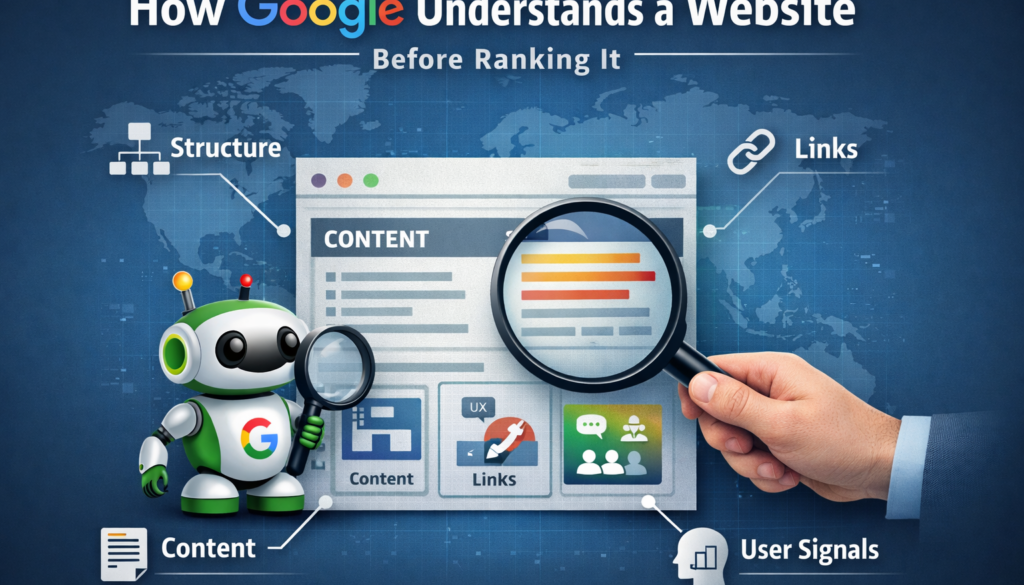
Google does not “see” a website as a human would. Google reads the text on a website to determine what a website is about. Google looks at how information is structured and how ideas are related to determine the main topic and search intent of a page before it determines how to rank the page. Before Google can rank a website, it evaluates on-page SEO elements like headings, keyword placement, and content clarity to understand what the page is about. To better understand how Google understands a website before ranking it, beginners should also refer to Google’s own explanation of how Search works.
Website Structure and Internal Linking Signals
One of the most powerful signals that helps Google understand a website is internal linking.
Internal linking assists Google in:
Understanding the relationship between pages
Finding key pages
Uncovering the content structure
For instance, I link my blog posts to other relevant pages, such as my on-page SEO, technical SEO, and portfolio pages, wherever it is contextually relevant. This helps Google understand topics rather than pages of isolated content.
This is an aspect that beginners usually overlook, but internal linking directly impacts how Google understands a website. This is the same approach I apply when structuring content and internal links across my own digital marketing portfolio, ensuring every page supports a clear ranking goal.
Content Relevance and Search Intent Alignment
Google does not rank content just because it exists. Google ranks content that matches the search intent.
Search intent refers to understanding why a user searched for something:
Are they searching to learn?
Are they searching to compare options?
Are they searching to solve a problem?
If the content does not match the search intent, the rankings will not work either. I organise my content using simple headings and explanations so that users can easily get their answers.
User Experience Signals Google Observes
Even before the rankings are strong, Google notices the interaction of users with a website.
The factors are:
Time spent on the page
Navigation patterns
Mobile-friendliness
Page loading speed
If users leave the website immediately or have difficulty navigating, Google considers this a bad experience. This is why SEO is not different from user experience. A well-organised layout, readable text, and logical flow benefit both users and Google.
Why Consistency Matters More Than SEO Hacks
One of the largest misconceptions that newbies have is that SEO hacks help websites rank. However, the truth is that Google can understand websites better with time through consistency.
Consistency in posting, linking, updating, and organising the website helps to build understanding and trust. Rather than looking for shortcuts, I concentrate on enhancing the basics of my website.
This helps Google to understand the website better before ranking it higher.
Final Overview
It is more important to understand how Google reads and interprets a website than to focus on ranking tricks. Before the ranking process, Google checks for clarity, relevance, structure, and experience.
As a beginner, my goal is not to optimise algorithms but to follow Google’s way. This portfolio site is my testing ground, and every optimisation helps Google understand it better.
Still learning, still testing, and improving step by step 😊
FAQ Section
1. How does Google understand a website before ranking it?
How Google understands a website before ranking it starts with crawling the site, analysing content relevance, evaluating site structure, and observing real user behaviour before assigning rankings.
2. Can beginners rank websites on Google without advanced SEO?
Yes. By learning how Google understands a website before ranking it and focusing on clear content, internal linking, and user experience, beginners can rank without complex or advanced SEO tactics.
3. Is keyword density important for how Google understands a website before ranking it?
No. How Google understands a website before ranking it depends more on context, relevance, topical clarity, and structure than on repeating the same keyword again and again.
4. How long does it take for Google to understand a new website before ranking it?
It varies, but consistent content updates, strong internal linking, and clear structure help speed up how Google understands a website before ranking it.