
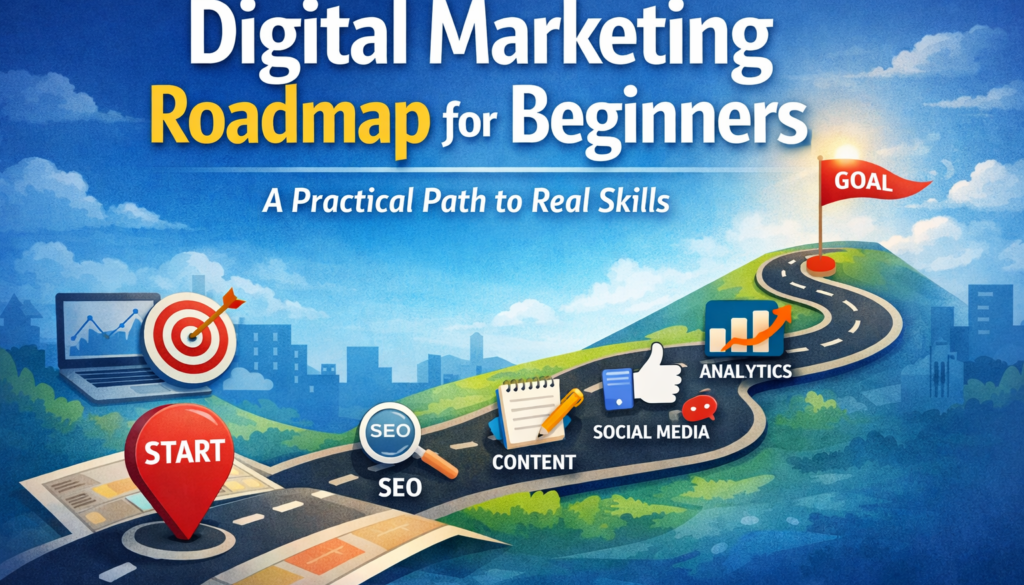
Digital Marketing Roadmap for Beginners: A Practical Path to Real Skills
Digital Marketing Roadmap for Beginners: A Practical Way to Build Real Skills
Most people start digital marketing with a lot of enthusiasm, but after a few weeks, they feel lost. One day, they are learning SEO, the next day they are watching videos on how to grow their Instagram following, and then suddenly, they are asked to start running ads. This is not because digital marketing is difficult. It is because people do not have a proper roadmap for learning digital marketing as a beginner.
Digital marketing is not about doing everything at once. It is about developing your knowledge in such a way that every skill you learn leads to the next one.
Why Beginners Feel Stuck in Digital Marketing
The internet is chock-full of advice, tools, and opinions. Newbies tend to dive right into strategy without grasping the larger context. They create content without understanding the objective, optimise pages without comprehending the purpose, or master tools without understanding their role in the strategy.
This is where a digital marketing roadmap for beginners comes in handy. A roadmap filters out the noise and provides guidance. It allows you to prioritise learning the correct information at the correct time rather than following the latest trends.
Step 1: Understanding How Digital Visibility Works
Before learning about any platform or tool, it is essential for newbies to grasp one fundamental concept: Digital marketing happens because people search, scroll, and decide online.
All digital platforms revolve around three fundamental concepts:
- Visibility: Being seen by the right people
- Trust: Being understood and believed
- Action: Helping users take the next step
Search engines optimise for relevance. Social media platforms optimise for engagement. Ads optimise for clarity. Once you grasp this, digital marketing won’t seem daunting anymore. This is the first step in any digital marketing roadmap for beginners. To better understand how search engines evaluate content, beginners can refer to Google’s own explanation of how Search works.
Step 2: Learning SEO as a Core Skill
SEO is commonly thought of as a technical skill, but at its heart, it teaches you how people search and how search engines interpret content.
In terms of my own learning journey, SEO is introduced relatively early because it assists new learners in understanding:
- Search intent and behaviour
- How to organise content in a way that is easy to understand
- How websites are organised
- Why do certain pages rank higher than others
While a person may go on to specialise in social media or advertising, SEO provides excellent foundational knowledge. This is why SEO is placed at the centre of a digital marketing roadmap for beginners rather than being considered an elective skill.
Step 3: Content With Purpose, Not Volume
Many newbies believe that digital marketing is all about sharing content daily. The truth is, purposeless content doesn’t work well.
The content I concentrate on is:
- About one topic per page
- Answers a question that matters
- Written in simple language
- Doesn’t have unnecessary filler content
Quality content isn’t measured by its length. It’s measured by its clarity. When users can easily grasp your message, they will spend more time on your page, interact with it, and trust you sooner. That’s why content is so important in a digital marketing roadmap for beginners.
Step 4: Using Social Media as a Support Channel
Social media is the first platform that beginners will likely interact with, but it is also the most misinterpreted.
Social media is more than just trends and posting every day. It is a channel of distribution. In a well-organised digital marketing roadmap for beginners, social media is employed for:
- Sharing and promoting content
- Creating familiarity and trust
- Assisting website traffic
- Establishing a long-term presence
Posting without purpose causes burnout. Posting with purpose helps in growing.
Step 5: Learning to Read Data, Not Fear It
Analytics can seem scary to newbies, but it doesn’t have to be.
You don’t have to use fancy analytics tools to get started. You just have to know:
- Where your traffic is coming from
- Which content is better
- How people are behaving on your site
- What you’re doing to get results
Analytics gives you data to improve, instead of just winging it. This step is where hard work turns into insight, and it’s a crucial part of a real-world digital marketing roadmap for beginners.
Step 6: Building Trust Through Consistency
This is where most newbies go wrong, not because they don’t have the skills, but because they quit too soon.
They put up a few posts, optimise a page, or try out a platform and then quit.
Digital marketing is effective when:
- Content is regularly updated
- New pages are added in an organised fashion
- Skills are honed on a regular basis
- Improvements are made over time
A digital marketing roadmap for beginners will only be effective if consistency is considered a skill and not an afterthought. Trust is earned over time, but once earned, the results are predictable.
Step 7: Connecting Skills Into a System
The largest change occurs when newbies no longer view SEO, content, social media, and analytics as different concepts.
They are not different. They all work together.
SEO = Intent-driven traffic.
Content = Knowledge creation.
Social media = Familiarity creation.
Analytics = Better decision-making.
When all these components are used together, digital marketing becomes a system, not a struggle. This is where the true power of using a digital marketing roadmap for beginners over random learning lies.
Final Overview
Digital marketing does not mean learning all the tools and platforms. It means understanding how visibility, trust, and action relate to each other.
Having a proper digital marketing roadmap for beginners can shift confusion to clarity. Once the basics are clear, learning tools will become simpler, understanding strategies will become easier, and achieving results will become more predictable.
This is how actual skills in digital marketing are developed. This is the same WordPress SEO process I apply across my portfolio while structuring websites for long-term visibility.